
- Service ▼
- Products ▼
✨ 20+ Years Experience | 5,000+ Global Brands All Products →
- Sustainability
- About Us ▼
- Related Resources ▼
- Contact Us
Short answer: A lid and base box is a two-piece packaging structure made from a separate lid and base tray. It is commonly produced from rigid grey board or coated paperboard and can be customized with printing, finishes and inserts for product protection and presentation.
Most overseas buyers ask the same three questions before a first order: what is the minimum, how is quality checked, and who carries the freight risk.
MOQ. Standard factory minimum is 500 pieces per size and print, which is low enough for a pilot run but high enough to absorb the setup cost. Orders at 5,000 and above move to a lower unit price because the die-cutting and printing setup is amortised.
Quality control. The process runs in four checkpoints: incoming board inspection, first-article approval against your signed sample, in-line checks during wrapping and assembly, and a final AQL inspection before packing. Photographs and inspection reports are issued at each checkpoint on request.
Freight and DDP. Boxes ship either assembled or flat. Flat shipment is the default for volume because the volumetric saving usually exceeds any assembly cost at destination. DDP terms are available, which means duty and clearance are handled before delivery — useful when your finance team needs a single landed cost rather than a freight invoice plus a customs bill.
Comparing structures for your product? Browse our custom lid and base boxes — FSC®-certified 1.5–3.0mm greyboard, half-cover, full-cover and shoulder & neck builds, MOQ 500 pieces.
View Custom Lid and Base Boxes →This structured, reusable package is useful when a brand wants a deliberate opening experience. The lid fits over the base, while the box can be adapted to different products, dimensions, materials, finishes and inserts. This guide explains the main styles, how they differ, and what to confirm before requesting a custom packaging quote.
A lid and base box, also called a lid and tray box, has two separate parts: a removable lid and a base tray that holds the product. Rigid versions are commonly made with grey board wrapped in printed paper, while folding versions can use coated paperboard for a lighter and more space-efficient format. The lid may cover part or all of the base, depending on the required protection and visual effect.
The structure is useful for products that need a stable presentation, a shaped insert or extra protection during handling. Common customization options include printed paper wraps, matte or gloss lamination, soft-touch coating, foil stamping, embossing, debossing, paperboard inserts, foam trays and molded-pulp components. See the custom lid and base box product range for available structures and finishes.
| Key factor | What to decide |
|---|---|
| Structure | Separate lid and base tray; choose half-cover, full-cover or deep-base construction. |
| Material | Rigid grey board, coated paperboard, corrugated board or another suitable board grade. |
| Protection | Use an insert, divider or tray when the product needs a precise fit or extra cushioning. |
| Branding | Select printing, paper, lamination, foil stamping, embossing or other surface finishes. |
A half-cover box leaves part of the base visible when closed, while a full-cover version places the lid over the entire base. The choice affects the opening feel, product visibility and the amount of board used. Half-cover designs can make the base and lid visually distinct; full-cover designs can create a more enclosed presentation and may provide additional protection around the product.

Half-cover box

Full-cover box
An insert helps hold the product in position and can organize multiple components inside the base tray. Depending on the product and target finish, an insert may be made from paperboard, corrugated board, foam or molded pulp. Before ordering, provide the product dimensions, weight, fragile areas and the required clearance so the insert can be designed around the actual item rather than a generic size. Explore boxes with paper inserts for an example.
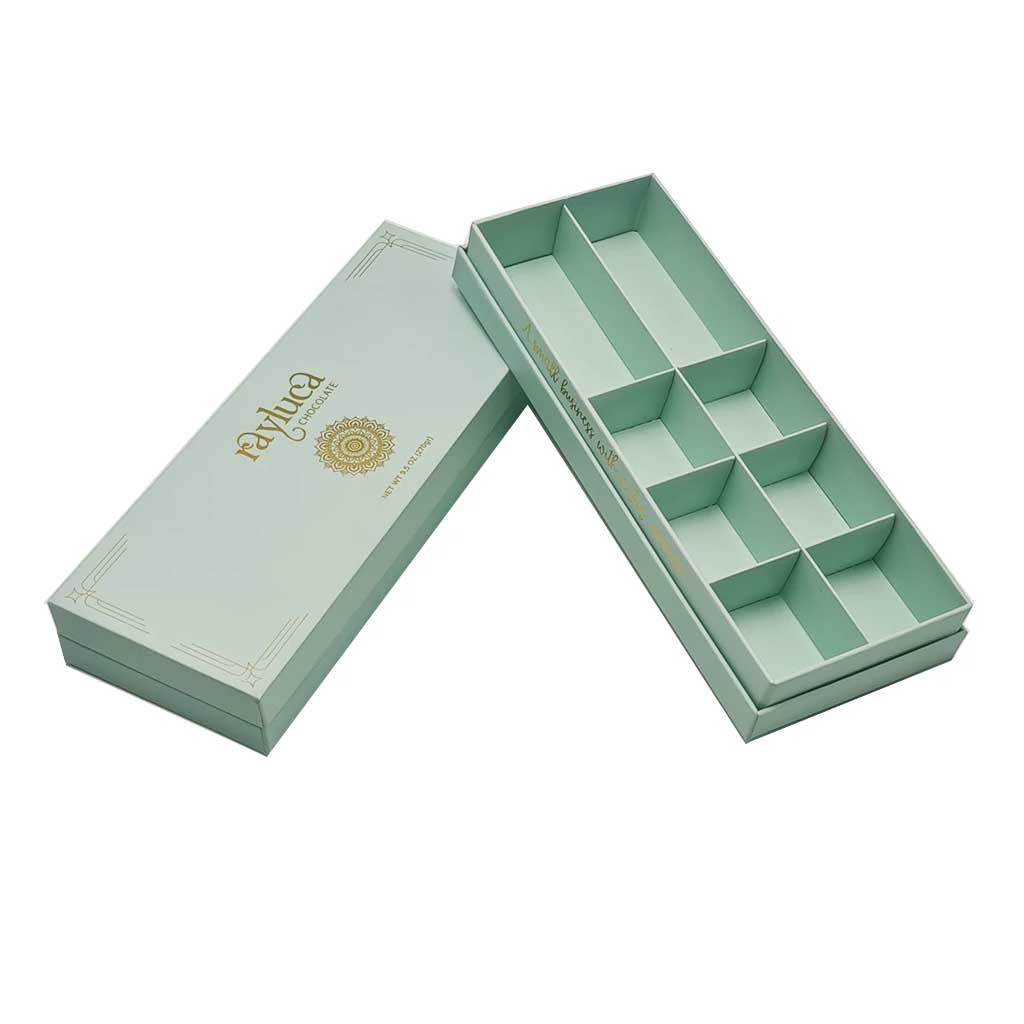
Box with paper insert
A deep-base design has a taller base and a shorter lid, sometimes with an internal collar. Its vertical profile can suit products that need more internal height or a more elevated presentation, including chocolates, candles, desserts and fragrance products. Confirm the product height, insert depth, lid clearance and shipping orientation before choosing this structure. See the deep-base packaging option for a related product example.

Deep-base box
Almost every lid and base box in production is one of three constructions. They differ in how deep the lid sits, how the base is built, and how much of the box is assembled before it leaves the factory.
| Construction | How it works | Best for | Watch out for |
|---|---|---|---|
| Full-telescope (full-depth lid) | The lid covers the full depth of the base, so the two pieces meet at the bottom edge. | Tall products, gift sets, anything that needs maximum side-wall protection. | Uses the most greyboard per unit and ships at the largest volume. |
| Partial-telescope (half-depth / shoebox) | The lid covers roughly half the base depth, leaving a visible band of the base. | Shallow products, confectionery, accessories, brands that want a two-tone split. | Less protection at the base seams; not ideal for heavy contents. |
| Shoulder and neck (three-piece) | An inner collar sits inside the lid or around the base, creating a stepped profile and a slower, cushioned close. | Premium fragrance, spirits, jewellery where the opening is part of the product experience. | Highest tooling and labour cost; tolerances must be tight or the fit feels loose. |
Two further variables sit on top of the construction itself: whether the box is supplied fully assembled or flat, and whether the base includes a false floor. A false floor raises the product so a short item still presents at the top of a deep box — the structure behind most deep base rigid boxes.
A lid and base box is not always the right answer. The comparison below sets it against the two structures it is most often shortlisted with, so you can rule options in or out before requesting samples.
| Structure | Opening experience | Freight efficiency | Best for |
|---|---|---|---|
| Lid and base box | Slow lift-off, strongest sense of ceremony | Ships assembled or nested; volumetric cost is highest | Hero products, retail shelf, press kits |
| Magnetic folding box | Magnetic snap, fast reveal | Ships flat, assembles on site — lowest landed cost at volume | High-volume gifting, e-commerce, subscription |
| Rigid drawer box | Sliding tray, ribbon or finger pull | Assembled; needs clearance for the drawer to travel | Multi-item sets, jewellery, sampling kits |
| Book-style box | Hinged like a book | Assembled; flat spine limits internal depth | Media, certificates, flat premium items |
Where a product is both fragile and presentation-critical, the usual answer is a rigid lid and base box presented inside a corrugated outer rather than shipped on its own.
The outer box sets the first impression; the insert decides whether the product arrives intact. Four insert families cover almost every brief.
| Insert | Protection | Presentation | Notes |
|---|---|---|---|
| Die-cut paperboard | Moderate | Clean, recyclable | Cheapest option; produced in-house from the same board |
| EVA or EPE foam | High | Contrasts well with paper | Cut to your product outline; needs a separate recycling stream |
| Moulded pulp | High | Natural, matt finish | Compostable; tooling cost per shape |
| Velvet or silk-covered tray | Moderate | Highest perceived value | Standard for jewellery and fragrance |
Board thickness is chosen against the product weight and the drop test the box must survive: 1.5mm greyboard for small, light items; 2.0–2.5mm for most gift and cosmetics work; 3.0mm where the box is handled roughly or reused. Surface finishes — foil stamping, embossing, spot UV, soft-touch lamination — are applied after wrapping, so they can be combined on a single panel without extra tooling.
Start with the product rather than the appearance of the box. Measure the product’s length, width and height, including any cap, closure or fragile projection. Then decide whether the box must protect the product during shipping, display it in a retail setting, hold several components or create a premium unboxing moment. These requirements determine the box structure, board grade, insert and finishing options.
| Style | Works well for | Confirm before ordering |
|---|---|---|
| Half-cover | Visible two-part presentation and easy opening. | Lid depth, visible base height and product clearance. |
| Full-cover | Enclosed presentation and additional coverage around the product. | Fit tolerance, lid friction and stacking requirements. |
| With insert | Fragile products, multiple components or precise product placement. | Product dimensions, weight, material and insert clearance. |
| Deep-base | Taller products and elevated presentation. | Internal height, collar, lid clearance and shipping orientation. |
This two-piece packaging design can combine structural protection with a branded surface. The lid and base may use the same paper, contrasting colors or different finishes to create a clear opening sequence. Printed artwork, foil stamping, embossing and debossing can add visual and tactile detail, while an insert can keep the product centered and reduce movement inside the package.
The final result depends on more than the artwork. Board thickness, paper selection, folding or wrapping method, adhesive, insert tolerance and transport conditions all affect the finished package. Request a digital proof and, when fit or protection is important, a physical sample before approving mass production. This makes it easier to check dimensions, color, finish, product fit and the opening experience together.
Prepare the following information before requesting a quote:
Providing these details helps a packaging manufacturer assess the structure, create a more accurate quotation and identify design issues before sampling. If you are unsure which structure fits your product, include product photos and dimensions so the design team can recommend an option.
Share your product dimensions, quantity and packaging requirements to discuss structure, inserts, sampling and finishing options.
Request a Custom Quote →A lid and base box is a two-piece packaging structure made from a separate lid and base tray. It is commonly produced from rigid grey board or coated paperboard and can be customized with printing, finishes and inserts.
Common types include half-cover boxes, full-cover boxes, boxes with paperboard or foam inserts, and deep-base boxes. The right style depends on product height, protection requirements and the desired opening experience.
Confirm the product dimensions, material, box style, insert, printing, finish, quantity, sample requirements, production lead time and shipping destination before requesting a quote. For brands planning a smaller first run, see our custom packaging for small business guide for practical MOQ and cost guidance.
Yes. Many structures can be supplied flat with self-lock corners or pre-applied adhesive strips, then assembled at your warehouse or fulfilment partner. The volumetric saving is usually the single largest cost reduction available on a repeat order.
1.5mm suits small, light items and shallow boxes. 2.0–2.5mm is the usual choice for cosmetics, fragrance and gift packaging. 3.0mm is specified where the box is heavy, handled repeatedly or expected to be kept and reused by the customer.
The greyboard and wrapped paper are FSC®-certified where the grade allows, and the certificate can be verified independently. Foam inserts are the exception — EVA and EPE need a separate recycling stream, which is why paperboard or moulded pulp is preferred where the sustainability claim matters.