- Service ▼
- Products ▼
✨ 20+ Years Experience | 5,000+ Global Brands All Products →
- Sustainability
- About Us ▼
- Related Resources ▼
- Contact Us
Quick answer: The most cost-effective custom packaging for a small business is a corrugated mailer box or folding carton built on a standard stock die-line, printed in one or two colors with digital printing, at a low minimum order of 500 pcs. This avoids tooling fees, ships flat to cut freight, and delivers factory-direct unit costs 30-50% below local distributors.
Every small business faces the same fork in the road. You can buy stock boxes off the shelf, or you can invest in custom packaging for small business growth. Stock boxes are cheap and available today, but they look generic, they rarely fit your product precisely, and they say nothing about your brand.
Custom boxes flip that trade-off. They fit your product, carry your logo, and travel through the postal system as a marketing asset. The catch is that custom packaging once demanded high minimum order quantities (MOQs) and expensive setup costs. For most products, that is no longer true.
Three questions decide whether custom packaging is worth it for you:
If you answered yes to two of these, custom packaging for your small business is not a luxury. It is a competitive baseline that separates you from sellers shipping plain brown boxes.
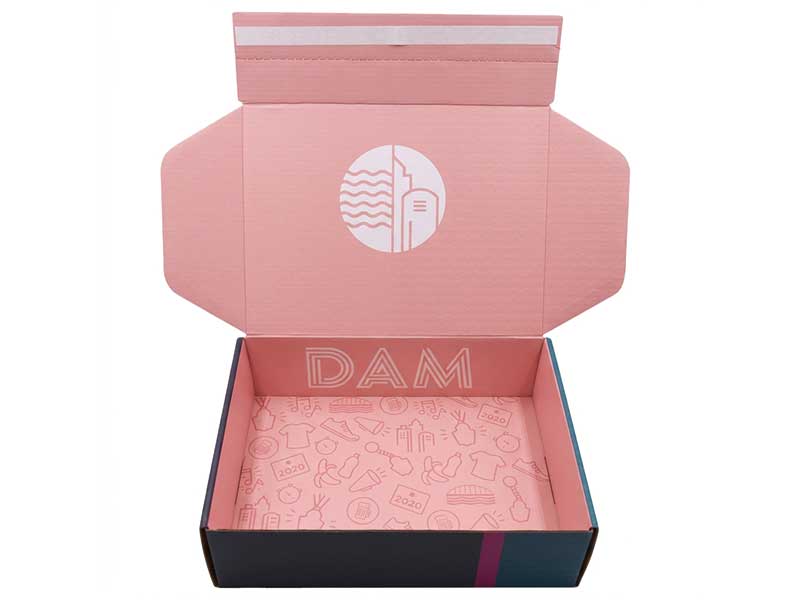
Custom branded boxes turn every shipment into a marketing touchpoint.
Budget is the number one reason small businesses delay custom packaging. The fear is that a factory will ask for 5,000 boxes when you only need 200. In reality, the MOQ depends almost entirely on your printing method and whether the box shape is standard.
Digital printing has no plate cost and almost no minimum, so it suits runs of 500 pcs. Unit prices are higher than offset, but you keep cash free and you can test a design before scaling. Offset printing requires plates and setup, so it becomes economical above roughly 1,000 units, where the unit price drops sharply.
The practical rule for small-business packaging is simple: start digital, then switch to offset once your design and volumes are stable.
A custom box shape needs a cutting die, which can cost $150-$500. You avoid that fee entirely by choosing a standard die-line — a ready-made template the factory already owns. Standard mailer, tuck-end, and shipping carton sizes are almost always tooling-free. Only fully custom shapes incur a die cost, so keep your first order within standard dimensions.
Handled this way, custom packaging for small business becomes an operating expense, not a capital project — one you can grow with instead of over-committing to.
| Order quantity (MOQ) | Recommended printing | Die-line / tooling fee | Unit cost trend | Best for |
|---|---|---|---|---|
| 500 pcs | Digital | None (standard die-line) | Highest — baseline 100% | First run, market test, crowdfunding |
| 500 pcs | Digital | None (standard die-line) | About 15% lower | Small-brand launch |
| 500 pcs | Digital → Offset boundary | None (standard die-line) | About 30% lower | Steady small-batch restocking |
| 1,000 pcs | Offset | None (spread across the run) | About 45–55% lower | Proven SKUs, long-term cost control |
The table shows the relative unit-cost trend by order volume, not a fixed price. Final pricing depends on box style, size, material and printing — request a quote for your specification.
For small business packaging, the box style you choose sets your cost, your protection level, and your unboxing feel. These four styles cover nearly every small business use case, and most brands end up combining two of them.
Corrugated mailer boxes are the workhorse of custom packaging for small business. They ship flat, lock without tape, and survive the postal system. They fit apparel, cosmetics, candles, supplements, and most DTC orders. This is the default recommendation unless your product is unusually fragile or ultra-premium.
Folding cartons are made from lightweight paperboard. They are inexpensive, light to ship, and ideal for retail shelves — think skincare, tea, or small electronics. They protect less than corrugated, so many brands place a folding carton inside a mailer or shipping box for a two-layer solution.
Rigid boxes use thick grey board wrapped in printed paper. They feel premium and hold their shape, but they cost more and are heavier to ship. Reserve them for high-ticket items or gifting, where the price justifies the presentation.
Heavy-duty custom shipping boxes handle the outer leg of delivery. They are the right choice for bulk, fragile, or multi-item orders, and they pair well with branded inner packaging.
For customers who want a premium reveal, magnetic folding boxes add a satisfying snap that standard cartons cannot match — a strong option for gift sets, PR kits, and high-value items.
| Box type | Best for | Protection | Relative cost | Typical small-business MOQ |
|---|---|---|---|---|
| Corrugated mailer box | Apparel, cosmetics, DTC & subscription | High | Low | 500 pcs |
| Folding carton | Retail shelf, skincare, tea, small electronics | Medium | Very low | 500-1,000 units |
| Rigid box | Premium gifts, high-ticket items | Very high | High | 500-1,000 units |
| Magnetic folding box | Luxury sets, gifting, PR kits | Very high | High | 500-1,000 units |
| Shipping carton | Bulk, fragile, multi-item e-commerce orders | Very high | Low to medium | 500 pcs |
Five popular box types for small businesses compared by use case, protection, relative cost, and typical minimum order quantity.
Material choice decides whether your product arrives intact. For corrugated packaging, the flute profile matters more than the box size, and it is the single biggest driver of both protection and cost.
E-flute is thin — about 1.5 mm — with a fine, smooth surface that prints beautifully. It is the standard for mailer boxes and retail packaging. B-flute is thicker at about 3 mm and stronger, making it better for shipping cartons and heavier goods. Many mailer boxes use E-flute walls with a reinforced base to balance looks and strength.
Rigid boxes are built from grey board, typically 1-2 mm for small boxes and up to 3 mm for large gift sets, then wrapped in 128-157 gsm art paper. Thicker board means a stiffer, more luxurious feel — and a higher freight weight, which small businesses should factor in early.
Recyclable kraft paper and FSC-certified board appeal to buyers who value sustainability. Kraft also gives a natural, uncoated look that reads as authentic — a low-cost way to signal your values without paying for premium finishes.
Get the size right before you buy materials. Our guide to measuring a box dimension shows how to measure length, width, and depth so your custom packaging fits on the first order instead of after an expensive mistake.
You do not need a big budget to look premium. Smart branding choices keep custom boxes for small business affordable while still standing out on the doorstep.
Inserts stop products from shifting and tidy up the unboxing. Cardboard inserts are the most affordable, foam inserts give the best protection for fragile goods, and molded pulp inserts are recyclable and eco-friendly. Match the insert to the fragility of your product, not to the price of the box — a low-cost mailer with a smart insert often beats an expensive box with none.
Where you buy matters as much as what you buy. Small businesses typically weigh two routes, and the gap in cost and flexibility is larger than most founders expect.
Local distributors offer speed and small-order flexibility, but they buy from factories and resell at a markup. You pay for convenience, and custom printing is often limited to a narrow catalogue of stock sizes.
Working directly with a packaging factory removes the middleman margin and opens up true customization — any size, any printing, any insert. Manufacturers in China now offer a factory MOQ of 500 pcs with free standard die-lines, which puts genuine custom packaging within reach of startups and side businesses.
When comparing quotes, always ask about:
With 20 years of production experience and 5,000+ brands served, Jinglin Packaging offers small-business-friendly MOQs, free standard die-lines, and full structural sampling. You can request a tailored free quote and sample to see the real cost before you commit to a single box.
Choosing custom packaging for small business comes down to three moves: pick a standard box style, print it in one or two colors, and order in small digital batches. Do that, and you get branded, protective packaging without cash-flow strain or tooling fees.
Start with a mailer box, keep your sizes standard, and reinvest early savings into a better unboxing. The brands that treat packaging as a growth tool — not a line-item cost — turn one-time buyers into repeat customers.
Get a free quote, low-MOQ pricing, and a physical sample for your branded boxes.
Request a Free Quote & Sample →For most small businesses, a corrugated mailer box is the best all-round choice. It ships flat to save freight, uses a standard die-line with no tooling fee, protects most products in transit, and creates a branded unboxing moment. Choose folding cartons for retail shelves, rigid or magnetic boxes for premium items, and shipping cartons for bulk or fragile orders.
Start with 100 to 500 boxes using digital printing. That volume is enough to test your design and size without tying up cash, and it keeps you above the minimum order for most suppliers. Move to offset printing and larger runs once your packaging is proven.
Yes, when you choose a standard box shape, print in one or two colors, and order in small digital batches. Avoiding custom dies and full-color printing keeps setup costs near zero, so the main cost is the box itself and the freight.
Choose a standard die-line that the factory already owns. Standard mailer, tuck-end, and shipping carton sizes require no new die, so there is no tooling fee. Only fully custom shapes need a new cutting die.
Look for a supplier offering 100 to 500 units for digital printing, or 500 to 1,000 units for offset printing. Low-MOQ factories make it possible for startups to order branded packaging without a large upfront commitment.
Use digital printing for runs under about 1,000 boxes because it has no plate cost. Switch to offset printing above 1,000 units, where the setup cost is amortized and the unit price drops significantly.
Sampling usually takes 3 to 7 days. Mass production typically takes 7 to 15 days depending on quantity and finishing, followed by shipping. Confirm lead times in writing before you order.
For most small businesses, the most cost-effective choice is a corrugated mailer box or folding carton built on a standard stock die-line, printed in one or two colors with digital printing, at a low minimum order of 500 pcs. This combination avoids tooling fees and reaches factory-direct unit costs 30-50% below local distributors.
Three levers cut cost as you grow. Keep the box on an existing stock die-line, print digitally until your run passes roughly 1,000 pieces and then switch to offset, and order the largest volume your cash flow allows so setup costs spread across more units. Shipping boxes flat also lowers freight.
No. Standard mailer, tuck-end, folding carton and shipping carton sizes use die-lines the factory already owns, so there is no tooling fee at any quantity. Only a fully bespoke shape needs a new cutting die, and that one-time cost is often waived or amortized at higher volumes.
Unit cost falls as volume rises and printing switches from digital to offset. At around 500 pcs the unit price is highest because setup is spread over few boxes; by 500 pcs it drops roughly 15-30%; at 1,000 pcs and above, offset printing typically reduces it a further 45-55%. Exact pricing depends on box style, size, material and printing, so always request a quote for your specification.