- Service ▼
- Products ▼
✨ 20+ Years Experience | 5,000+ Global Brands All Products →
- Sustainability
- About Us ▼
- Related Resources ▼
- Contact Us
This guide explains how to make that decision step by step. For a broader overview of fragrance packaging decisions, see our guide on how to choose perfume packaging for your brand.
Before choosing a box style, document the physical requirements of the product:
A presentation box designed only for a retail shelf may not provide enough protection for parcel delivery. Conversely, a heavily engineered shipping pack may make a premium shelf product feel unnecessarily industrial. Map the journey from filling line to customer before approving the structure.
Different structures create different opening experiences and production trade-offs.
| Box structure | Best suited to | Main advantages | Watch-outs |
|---|---|---|---|
| Reverse-tuck or straight-tuck carton | Everyday retail ranges, lightweight bottles | Efficient, familiar, easy to store | Needs a well-designed insert for heavier bottles |
| Two-piece rigid box | Premium launches, gift sets, high-touch unboxing | Strong perceived value and presentation | Higher material, assembly, and shipping requirements |
| Magnetic rigid box | Luxury collections and reusable gift packaging | Clear opening ritual and strong shelf impact | Magnet placement, cost, and recyclability need review |
| Drawer-style box | Discovery sets and giftable products | Memorable reveal and good internal organization | More components and tighter tolerance requirements |
| Book-style box | Collections, limited editions, storytelling-led brands | Large printable area and distinctive opening | Hinges, wrap materials, and edge finishing require testing |
Use a rigid structure when presentation and long-term perceived value justify the additional cost and logistics. Use a folding carton when efficient packing, a lower pack footprint, and easier high-volume handling matter more.
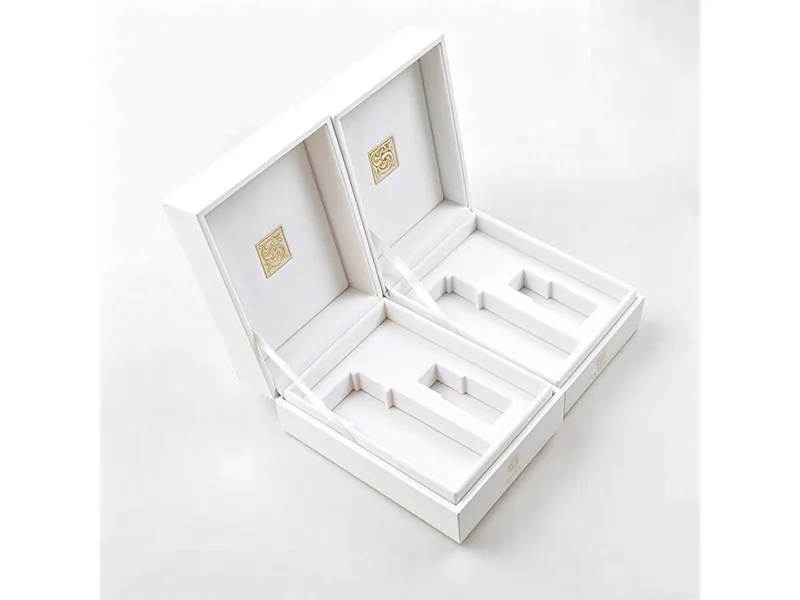
The insert is often the most important protection component. It should hold the bottle firmly without putting excessive pressure on the glass, cap, or atomizer.
Common box inserts include paperboard, molded pulp, foam, and custom-fit board constructions. The correct option depends on the bottle geometry, required presentation, production volume, and end-of-life expectations.
A practical insert review should answer these questions:
Do not approve the outer box from a flat artwork file alone. Request a structural sample with the real bottle or a dimensionally accurate mock-up.
Materials and finishes should reinforce the fragrance’s intended character rather than compete with it.
A useful rule is to define one primary visual signal and one tactile signal. For example, a restrained color system plus a debossed mark may communicate more clearly than several competing finishes.
Sustainability claims should be based on the actual material and finishing specification. Ask the supplier to document the paperboard grade, coatings, adhesives, insert material, and any non-paper components.
For brands selling into Europe, packaging planning should also account for current regulatory developments. Regulation (EU) 2025/40 aims to make packaging reusable or recyclable by 2030 and includes requirements related to packaging waste, materials, and design. The practical implication is that a premium perfume box should be reviewed as a complete system rather than judged only by the outer paper surface.
Before using a claim such as “recyclable,” confirm:
Avoid vague sustainability language when the specification has not been verified.
Perfume bottles are fragile, and packaging can be damaged by more than a single drop. Distribution may involve vibration, compression, handling impacts, and changes in orientation.
ISTA provides packaging testing resources and test methods for distribution environments. A brand does not need to use the same test plan for every SKU, but it should define a test protocol appropriate to the route to market. At minimum, test a representative pack with the intended bottle, insert, and finished graphics.
A sensible approval sequence is:
The goal is not to make every box indestructible. The goal is to identify failure modes before they become customer complaints or product loss.
Supplier comparisons become unreliable when each supplier quotes a different structure or specification. Send the same brief to every candidate, including:
Compare more than the unit price. Review tooling, sampling, assembly, packaging for shipment, lead time, quality-control steps, and the cost of future changes.
A lower initial quote may not be lower after adding a custom insert, special finish, manual assembly, or additional protective shipping packaging.
A simple scorecard can make the final decision more objective. Suggested categories include:
Give the highest weight to the factors that could create an expensive failure. For a fragile bottle sold through direct-to-consumer shipping, protection and fulfillment performance may deserve more weight than a small difference in decorative finish.
A two-piece rigid box, magnetic rigid box, or book-style box can work well when the opening experience and presentation justify the added cost. The best choice still depends on the bottle, insert, distribution route, and production volume.
No. Rigid boxes can offer a stronger premium experience, while folding cartons can be more efficient for storage, shipping, and high-volume retail. Protection depends on the complete structure and insert, not only on whether the box is rigid.
Paperboard, molded pulp, foam, and custom board inserts can all be appropriate. The decision should consider bottle geometry, movement control, presentation, production requirements, and the disposal or recycling plan.
Start by reducing unnecessary components, selecting materials that fit the target disposal system, minimizing mixed-material construction where practical, and documenting the full specification. Do not make a recyclability claim until the complete pack has been reviewed.
Yes. A representative sample should be checked with the real bottle or an accurate dummy. The test plan should reflect the actual sales and distribution channel, including likely handling and transport stresses.
Ask for structural samples, material specifications, insert details, finish samples, quality-control procedures, testing options, tooling information, production lead time, packing details, and documentation supporting any sustainability claims.
There is no universal number, but a focused finish strategy is usually easier to recognize and control. Select finishes that support the brand’s main visual and tactile message instead of adding effects without a clear purpose.
Choose the perfume packaging box as a complete product-protection and brand-experience system. Begin with the bottle and distribution journey, select the structure, design the insert, verify the materials and finishes, test a representative sample, and compare suppliers against one identical brief.
For a custom packaging project, a supplier such as Jinglin Packaging can be evaluated using this same framework: ask for a structure proposal, sample, material specification, testing plan, and a transparent quotation before approving production.