
- Service ▼
- Products ▼
✨ 20+ Years Experience | 5,000+ Global Brands All Products →
- Sustainability
- About Us ▼
- Related Resources ▼
- Contact Us
Both techniques press artwork into the board with a metal die. One pushes the surface up, the other sinks it in — and that single difference changes how light, fingerprints and photography behave on your shelf.
There is also a third option that most buyers overlook: blind embossing, where you emboss with no foil and no ink so the shape exists only as relief and shadow. It is the most understated premium signal you can put on a lid, and it is the cheapest of the three because it skips the foil pass entirely.
A quick rule our engineers give brand owners: if the product is sold from a shelf where boxes sit shoulder to shoulder, emboss the front panel. If it is a gift that is opened by hand in a calm setting, deboss the lid and emboss the insert card. That combination gives you shelf presence where it matters and quiet luxury where it counts. If your carton is a folding cardboard or corrugated structure rather than a rigid box, read the material note in section 04 first — the flute changes the answer.

Embossing — the logo is raised above the wrap and catches light at an angle.
Buyers handle a box for two to four seconds before they read anything. A raised or recessed mark breaks the flatness of that moment and makes the hand stop, which is exactly the pause your brand needs. On luxury rigid boxes for cosmetics, fragrance or spirits, that pause is often the difference between a photo and a purchase.
Four-colour printing on a flat wrap reads as flat, especially in mobile photographs. Relief introduces real highlights and real shadow, so the same logo looks more dimensional in a live listing, a paid ad and a shelf photo without a single extra shoot day.
Once a raised monogram or a recessed crest is established, it becomes part of the brand’s physical vocabulary. Customers use it to check authenticity, and it makes counterfeits obvious because relief is expensive to fake convincingly.
The finishing cost per unit is usually measured in cents, but the perceived value it unlocks is measured in dollars. Across the projects we produce, embossed and debossed embossed packaging consistently supports a premium price position — as long as the depth is right, which is where many brands lose money in the details covered next.

Debossing — recessed artwork stays crisp on dark, soft-touch and linen wraps.
This is the single most common finishing failure we are asked to repair, and it almost always originates in the artwork or the process order rather than the press. Foil is a metallic film a few microns thick. It cannot stretch. So when a factory stamps foil across the shoulder of an existing emboss, the film tears along the edge — you get a cracked, leaking or milky outline that looks like a printing defect at any close-up price.
If your logo has very fine strokes, thin serifs or a small line of text, ask about debossed foil: the foil is stamped into a recess so the metal sits below the surface and is protected from abrasion. It survives shipping and handling far better than a raised foil edge, which is why fragrance and jewellery projects so often prefer it. Combine it with a soft-touch lamination and the recessed metal reads as genuinely expensive in the hand.
For very fine detail, stick to a minimum stroke of about 0.6 mm and no type smaller than roughly 7 pt. Below that, the die simply cannot press a clean relief, and no amount of press adjustment will rescue the artwork.

Foil registered inside the emboss shoulder — the combination that survives handling.
Buyers tend to negotiate the unit price and ignore the tooling line, which is backwards. The die is usually a one-time charge quoted per artwork, not per box, so its cost per unit collapses as quantity rises — while a badly specified process adds cost to every single unit forever. A standard emboss die for a logo under roughly 100 × 100 mm is normally priced in the low hundreds of US dollars; multi-level or brass tooling for very fine detail costs more, and every additional size in the same order needs its own die.
On quantity, tooling amortises quickly once you pass roughly 1,000 rigid boxes, which is why most of our clients run a 500–1,000 piece pilot and then scale. If you are still deciding on structure, the cost mechanics in our guide to how to buy custom rigid boxes sit alongside this one and cover quoting, sampling and lead times in detail.
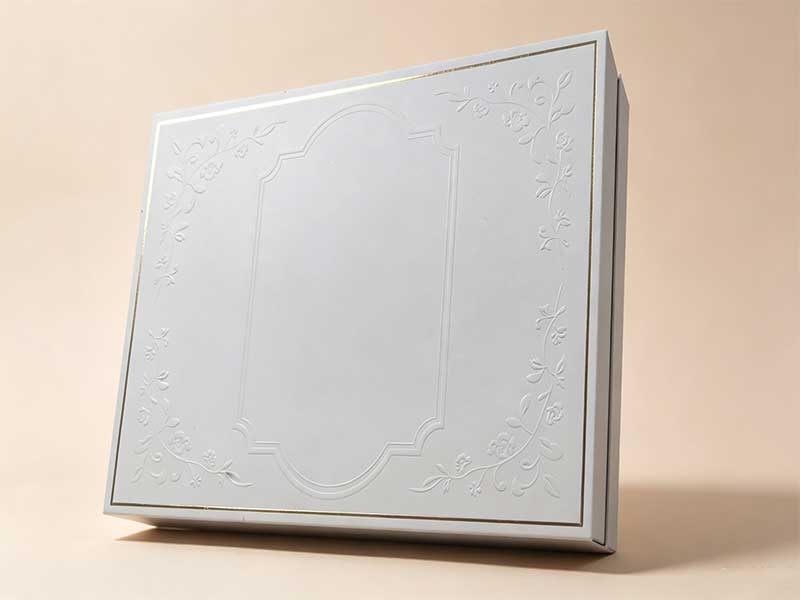
Jinglin’s high-end magnetic embossing box — relief and foil registered to the same profile.
The right relief depends on the structure it sits on. These are the pairings our engineers recommend most often, together with the guides that go deeper on each format.
Across all of these, the base structure is the same family of premium formats covered in our rigid paper boxes range and in how magnetic paper boxes elevate your brand image. If you are still weighing finishes against each other, the lamination and spot-UV options sit in the same finishing service toolkit as embossing.
Embossing and debossing are the cheapest premium signal in packaging — but only when the die, the board, the wrap and the process order are specified together. Get those four right and a raised logo becomes a sales argument; get them wrong and it becomes a reject report. Whether you are choosing between embossing and debossing for a new launch or fixing a foil edge that keeps cracking, Jinglin Packaging handles the finish in-house, from die engraving and foil registration to the final press check.
Free finishing consultation, a physical emboss and deboss mock-up on your chosen board, and a no-obligation quote within 24 hours.
Get Your Free Quote →Choose embossing when the logo should catch light and be felt from across a shelf, and debossing when you want an understated, engraved look that stays clean on textured or dark wraps. Many premium rigid boxes use debossing on the lid and embossing on the insert card. For dark soft-touch or linen wraps, debossing usually reproduces more cleanly than embossing.
Foil is a thin metallic layer that cannot stretch, so stamping it across a sharp emboss shoulder tears the film. The fix is process order and die geometry: foil first, then blind emboss with a registered male die of the same profile; keep the foil edge at least 0.5 mm inside the emboss shoulder; use a rounded shoulder of about 45°; and reduce emboss depth to roughly 0.25–0.4 mm on 1200–1500 gsm grey board.
A standard magnesium or copper emboss die for a logo under about 100 × 100 mm is normally a one-time tooling charge in the low hundreds of US dollars, quoted per artwork rather than per box. It is reusable for the life of the design and across repeat orders. Multi-level or brass dies for very fine detail cost more, so approve artwork and board thickness before tooling is cut.
Rigid grey board wrapped in coated, soft-touch or linen paper holds detail best, which is why embossed rigid boxes feel so crisp. Thin folding carton stock and single-wall corrugated mailers need a wider stroke, a shallower depth and often a counter die, because the flutes compress under pressure. Always test the exact board and wrap combination before production.