- Service ▼
- Products ▼
✨ 20+ Years Experience | 5,000+ Global Brands All Products →
- Sustainability
- About Us ▼
- Related Resources ▼
- Contact Us
The EU Packaging and Packaging Waste Regulation (PPWR) is no longer a future proposal. It has applied generally since 12 August 2026, and it changes what a custom box has to achieve: not only a strong brand impression, but also recyclable packaging performance, measured empty space, documented materials and a clear responsible operator. For brands that buy custom packaging, the practical question is no longer whether the box looks premium — it is whether the box can be placed on the EU market at all.
This guide explains the parts of the regulation that most directly affect custom packaging design, sourcing and documentation. It is written for brand owners, product teams and packaging buyers who need to turn a compliance obligation into a workable packaging brief.
One of the most consequential clarifications in the PPWR concerns who is legally responsible for a custom box. Under the regulation, a manufacturer is the party that makes a packaging unit or has it designed or manufactured under its own name or trademark. When a brand commissions a custom box from a converter and that box carries the brand’s name or logo, the brand is treated as the manufacturer — not the factory.
This matters because the “manufacturer” carries the conformity assessment, technical documentation and EU declaration of conformity obligations. A contract manufacturer that simply follows the brand’s design instructions does not absorb that legal responsibility. The Commission’s guidance and FAQ also address the so-called “trademark tape” scenario: sealing generic boxes with branded tape can still assign primary manufacturer liability to the trademark owner.
Separately, EPR responsibility is defined by the operator that first places the packaging on the market in the member state where it becomes waste. A company can therefore be both manufacturer and producer, or only one of the two, depending on the supply chain. Importers and distributors have their own due-care and documentation duties.
The regulation entered into force in February 2025 and applies generally from 12 August 2026. Key milestones for custom packaging buyers include:
The 2030 date is the one that should shape design decisions made today. A custom box developed in 2026 with a multi-material laminate, an oversized cavity and no recyclability documentation may be difficult or expensive to keep on the EU market by the end of the decade.
From 2030, packaging must meet design-for-recycling criteria. Reporting on the regulation indicates that a minimum Grade C recyclability level is required by 2030, with at least 70% of packaging recoverable by weight. By 2035, recyclability at scale becomes mandatory.
For custom packaging, this creates a direct tension with some conventional luxury constructions. Magnetic rigid boxes with mixed substrates, foam inserts, metallic foils and plastic windows can be visually effective but harder to recycle. The regulation does not ban them outright, but it pressures complex multi-material formats toward simpler, mono-material designs — the same direction that defines credible recyclable packaging today.
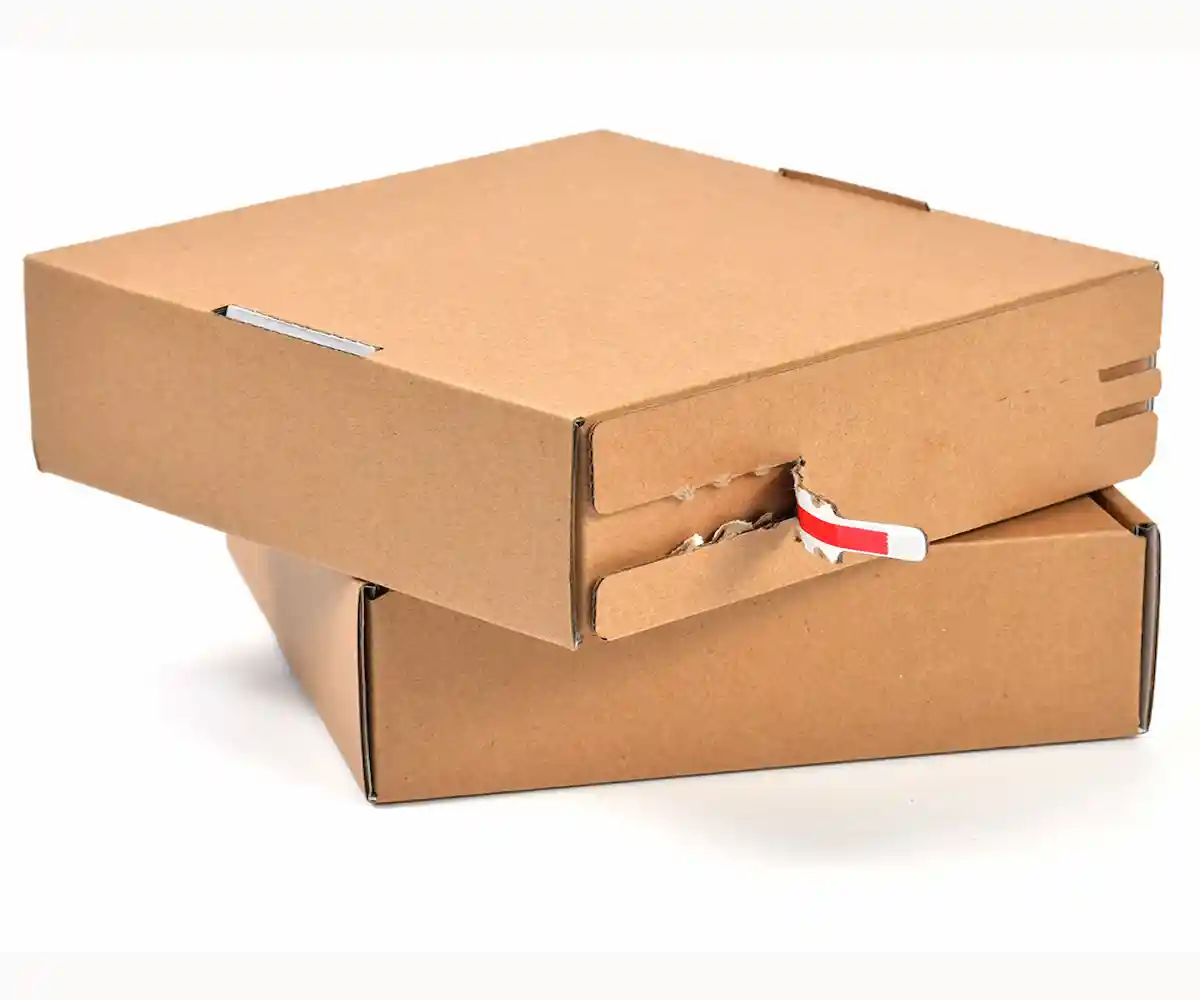
A mono-material mailer box with a tear strip ships flat, uses less volume and is easier to recycle than a mixed-material luxury box.
A practical response is to treat recyclability as a design brief from the start. Choose a dominant material, minimise incompatible coatings, and design inserts that can be removed easily. If a premium effect is essential, test whether it can be achieved within the chosen recycling stream rather than adding it as a separate layer.
From 2030, certain transport and e-commerce packaging must not exceed a 50% empty-space ratio. In practice, this means a shipping box should be at least half full of product, not filler. Brands that rely on a small number of standard box sizes and paper void fill will need to rethink dimensional planning.
For custom packaging, the fix is earlier measurement. A box should be designed around the filled product, including caps, pumps and secondary components, rather than around a generic outer dimension. Reducing unused volume also lowers board consumption and freight cost, so the compliance requirement can align with commercial efficiency.
Extended producer responsibility requires the producer to finance the recovery of packaging waste in the member state where it becomes waste. Under the PPWR, packages that are difficult to recycle face higher fees, while simpler recyclable designs benefit from lower costs.
This changes the economics of custom packaging. A complex box with a low unit price can carry a higher effective cost once EPR modulation is included. A slightly more expensive mono-material box may be cheaper over the compliance cycle. Brands comparing quotes should ask suppliers for material composition and recyclability data so the EPR exposure can be estimated alongside the unit price.
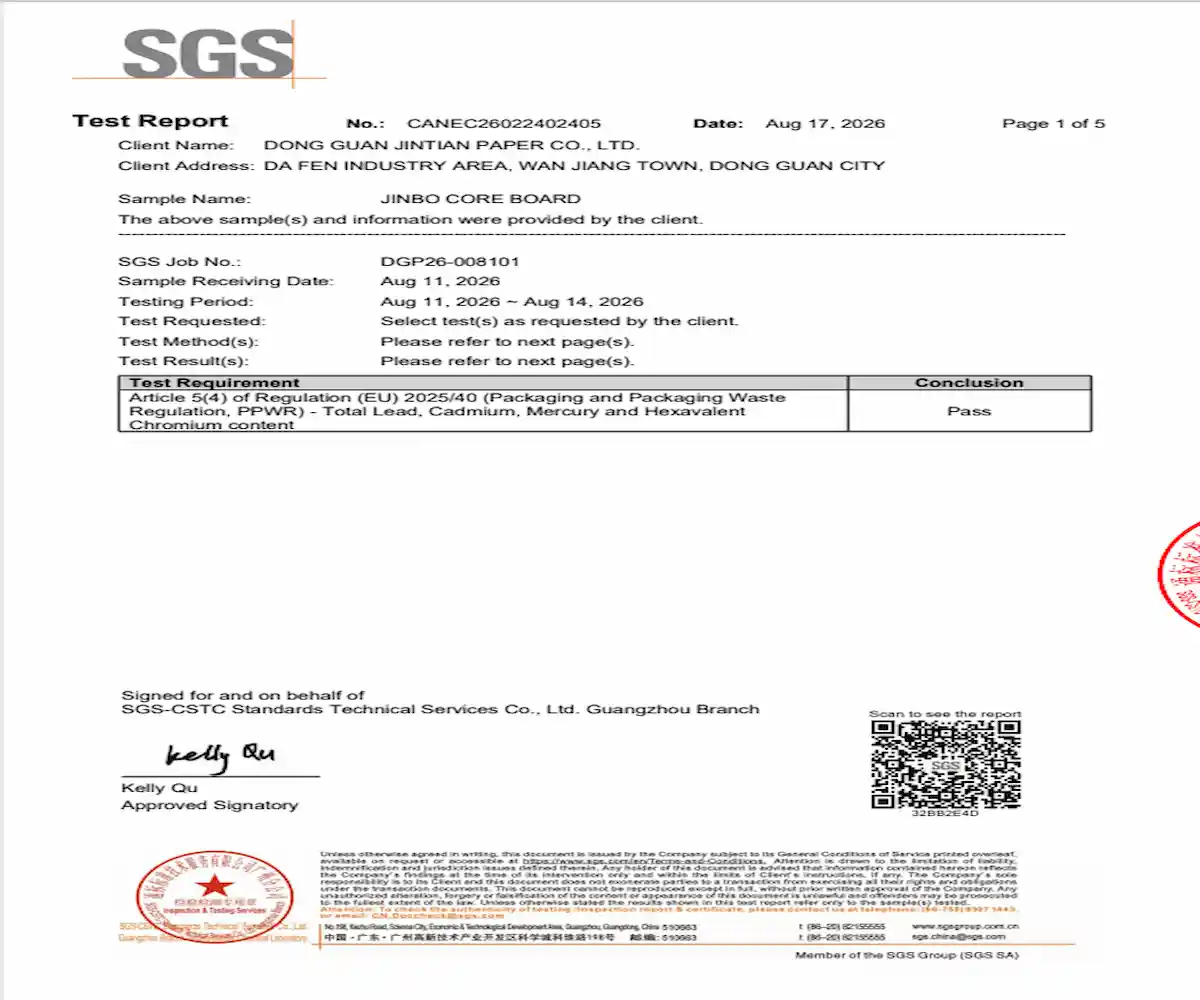
Jinglin Packaging holds PPWR certification, alongside FSC and ISO 9001, to support recyclable packaging specifications for the EU market.
The PPWR introduces a mandatory declaration of conformity and technical documentation for packaging placed on the EU market. Importers may need material composition data, packaging weight, test results and declarations of conformity. Suppliers are required to provide this documentation and cannot refuse a manufacturer’s data request.
For custom packaging, this means the artwork and dieline are no longer the whole brief. A brand needs a specification that records substrate, coating, adhesive, insert material, weight and recyclability grade. This data also supports CSRD reporting, where packaging materials, recycled content and recyclability are increasingly part of environmental disclosure.

Each approved sample should be matched with a documented material and recyclability specification for conformity and reorder consistency.
Folding cartons remain a practical starting point for EU compliance. They are typically mono-material, ship flat and use less volume. Rigid boxes can still be used, but the material mix should be simplified and the insert designed for easy separation. Magnetic closures need documentation of the magnet type and removal route; the closure should not prevent the paper stream from being recycled. Plastic windows are increasingly difficult to justify unless they can be separated or the format can be redesigned as a paper window or open-front structure.
The safest approach is to ask the packaging supplier for a compliance-oriented structure review before artwork. Jinglin’s rigid paper boxes and corrugated mailer boxes can be evaluated against recyclability and empty-space requirements, while custom shipping boxes should be sized against the real filled product.
A supplier can only help with compliance if the brief contains the right information. Before requesting a quote for the EU market, prepare:
Ask the supplier to confirm material composition, recyclability grade, empty-space ratio and whether they can provide technical documentation. Jinglin’s quote and sample request page is the right place to provide these details. If you are still comparing structures, start with the custom packaging product range and the guide to buying custom rigid boxes.
Compliance does not have to mean generic packaging. It means making the premium signal compatible with the material system. Ask three questions before approving a custom design: Which material dominates the package by weight? Can the insert and closure be separated without tools? Does the box volume match the filled product? If the answer to those questions is clear, the design is more likely to remain viable as the 2030 requirements apply.
The brands that benefit most are those that treat PPWR as a design input rather than a late-stage audit. A packaging specification built around recyclability, measured volume and documented materials is easier to repeat, easier to report and less exposed to EPR cost changes.
Contact the Jinglin Packaging team to confirm PPWR, FSC and ISO 9001 certification for your project. Share your product dimensions, target market, preferred structure and quantity, and we will help you build a compliant, recyclable packaging direction for the European market.
Contact Jinglin Packaging →The PPWR applies generally from 12 August 2026. Packaging minimisation, recyclability by design and recycled content requirements apply from 1 January 2030, with full recyclability at scale from 2035.
Yes. If the packaging carries the brand’s name or trademark, the brand owner is generally treated as the manufacturer under the PPWR, even when a contract manufacturer produces the box. The brand is responsible for conformity assessment and technical documentation.
From 2030, certain transport and e-commerce packaging must not exceed a 50% empty-space ratio. Brands should measure the real product and reduce unused volume rather than using a standard oversized box with filler.
They can be, but recyclability requirements become stricter from 2030. Complex multi-material constructions face higher EPR fees and redesign pressure. Mono-material or easily separable designs are generally easier to document and recycle.
Brands should collect material composition, packaging weight, recycled content, recyclability grade, restricted substances and supplier declarations. This data supports PPWR conformity and CSRD packaging reporting.